



By: JMPC Team
Jun 08, 2026
It’s a Good Time to Review Your Rental Properties—Maybe It’s Time for a 1031 Exchange in Los Angeles
If your rental portfolio feels heavier to manage than it used to, 2026 may be the right moment to review performance, risk, and next-step strategy. For some Los Angeles owners, that review leads to one question: should you hold, sell, or consider a 1031 exchange?
Estimated reading time: ~5 minutes.
Why 2026 is a good year to review your rental portfolio
In Los Angeles, rental conditions look cooler than they did during the frenzy years. Zillow’s Los Angeles rental data, updated April 13, 2026, shows an average rent of about $2,656 with a month-over-month decline of $39 and a year-over-year decline of $89, and labels the market temperature as cool. At the same time, Zillow’s national 2026 outlook says multifamily rents are expected to stay roughly flat while elevated vacancies and recent supply continue to pressure pricing. (zillow.com)
That does not mean every owner should sell. It means this is a strong moment to ask better questions:
Ask these 5 questions about each property
- Is rent growth still justifying the headaches?
If income is flat but repairs, compliance, and management effort keep rising, the asset may no longer be pulling its weight. (zillow.com) - Are you overexposed to one building type or neighborhood?
Concentration risk is real. A portfolio review can reveal whether too much of your equity sits in one kind of property. - Would a different asset serve your life better?
Some owners want fewer turns, newer systems, stronger cash flow, or a different management profile. - Are you still holding for investment—or just out of inertia?
This one matters. A 1031 exchange only applies to real property held for investment or productive use in a trade or business, not property held primarily for sale or personal-use homes. (irs.gov) - Do you have enough unrealized gain that taxes would materially affect your exit?
If yes, a 1031 may deserve serious review with your CPA and exchange team. The IRS says a properly executed like-kind exchange can postpone current gain recognition by shifting basis to the replacement property. (irs.gov)
What a 1031 exchange actually does
A 1031 exchange is not magic. It is a tax-deferral mechanism for qualifying exchanges of real property held for business or investment into other like-kind real property. In plain English: investment real estate can often be exchanged for other investment real estate, even if the assets differ in grade or quality. The IRS explicitly notes that real property used for personal purposes, like your home, does not qualify. (irs.gov)
The simple version
- You sell an investment property.
- You do not take constructive receipt of the proceeds.
- A qualified intermediary is typically used in a deferred exchange structure. (irs.gov)
- You identify replacement property within 45 days. (irs.gov)
- You must receive the replacement property by the earlier of 180 days after transfer or your tax return due date, including extensions, for that year. (irs.gov)
- You report the exchange on Form 8824. (irs.gov)
Pro Tip: The 1031 decision is not just “How do I avoid tax?” A better question is: “Can I move this equity into a property that fits my next 5 years better?”
Signs a 1031 exchange may be worth exploring
A portfolio review does not always end in a sale. But these are common signs that a 1031 conversation may be justified:
1) Your property is management-heavy
Older buildings with constant deferred maintenance, high turnover, or operational friction can drain time and money. A newer or better-positioned replacement asset may be more aligned with your bandwidth.
2) You want to consolidate or simplify
Some investors want to trade multiple smaller properties into one easier asset. Others want the reverse: exchange one large, risk-heavy property into multiple assets.
3) Your current asset still has equity, but weaker momentum
LA rent softness does not mean bad assets everywhere. It does mean you should be more selective. If your current building has appreciated well but future upside looks thinner, reviewing exchange options is rational. Zillow’s 2026 rental data and outlook both support a more measured underwriting environment than the spike years. (zillow.com)
4) You want a stronger fit with today’s market
Some owners are moving toward:
- lower-turnover assets,
- neighborhoods with steadier tenant demand,
- properties with simpler maintenance profiles, or
- assets that better support long-term retirement or estate planning goals.
What to review before you make a move
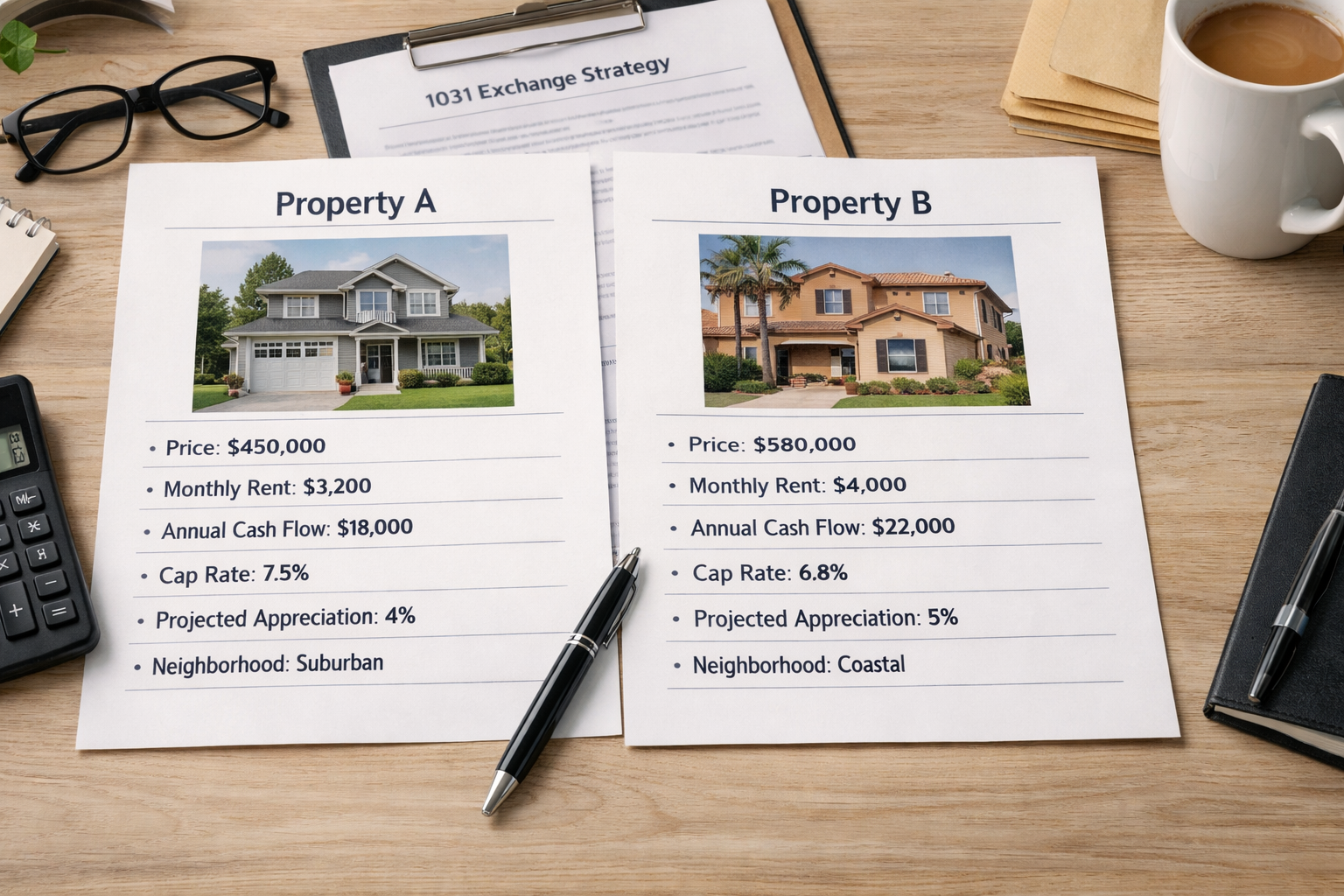
A smart owner does not jump straight from “I’m tired of this property” to “Let’s exchange it.”
Review these first
Property performance
- Actual collected rent
- Vacancy/turn cost
- Maintenance history
- Insurance and tax trend
- Net operating reality, not spreadsheet fantasy
Portfolio fit
- Asset type concentration
- Neighborhood concentration
- Debt structure
- Management complexity
Exchange readiness
- Estimated gain and depreciation recapture exposure
- Ownership structure
- Whether the property clearly qualifies as investment/business-use real estate
- Whether you have your CPA, qualified intermediary, and broker strategy aligned
Replacement criteria
- Minimum return target
- Geography
- Maintenance tolerance
- Tenant profile
- Exit horizon
Los Angeles-specific nuance in 2026
This is where owners get tripped up: they treat a 1031 as a tax move only, when in reality it is a market + operations + tax move.
In LA, 2026 is a strange mix:
- asking rents are softer than many owners expected, (zillow.com)
- multifamily conditions nationally are flatter because vacancy and supply are still pressuring pricing, (zillow.com)
- but LA still remains an expensive and deeply supply-constrained long-term market by national standards. HUD’s FY 2026 Fair Market Rent schedule for the Los Angeles-Long Beach-Glendale area lists $2,085 for a 1-bedroom and $2,601 for a 2-bedroom, which is a reminder that replacement property underwriting still needs discipline. (huduser.gov)
That combination creates a useful tension:
this may not be the best year to buy blindly, but it may be a very good year to review strategically.
Mini-case vignette
An owner has a small older rental in LA with strong embedded equity, aging systems, uneven rent growth, and constant maintenance interruptions. On paper, the building still looks “fine.” In real life, it keeps stealing attention. After reviewing the real net income, repair burden, and tax implications, the owner realizes the better question is not “Should I keep it forever?” but “Would a different property serve me better with the same equity?” That is exactly the kind of moment where a 1031 review becomes useful.
— Internal Links —
- HOA and owner support that protects long-term value → /owners
JPMC’s owner-focused services are a natural fit if you want a cleaner view of performance before deciding whether to hold, sell, or reposition. (jpmchomes.com) - Financial clarity before strategic decisions → /accounting-financial
If you are reviewing rent performance, expenses, and operational reality, JPMC’s accounting and financial support is directly relevant. (jpmchomes.com) - Talk through your next move with JPMC → /contact
JPMC’s contact page gives owners a direct way to start a conversation about portfolio review, operations, and next-step strategy. (jpmchomes.com)

If you own rental property in Los Angeles and want a clearer view of whether it still fits your goals, JPMC can help you review the operational side before you make a bigger move. Start a quick consult with JPMC.
Deck / TL;DR
- A 1031 exchange can still defer current gain recognition on qualifying investment real estate in 2026. (irs.gov)
- The big timing rules are still the 45-day identification window and 180-day completion window. (irs.gov)
- LA rent conditions look cooler in 2026, which makes portfolio review more important, not less. (zillow.com)
- This is not just a tax choice. It is a market, operations, and fit decision.
- A smart review starts before you list anything.
FAQs
Q: Can I use a 1031 exchange for my primary residence?
A: Generally no. The IRS says real property used for personal purposes, such as your home, does not qualify for like-kind exchange treatment. (irs.gov)
Q: Do I have to buy the exact same type of property?
A: No. For qualifying real estate, “like-kind” is broad. IRS guidance says real estate for real estate generally qualifies if both properties are held for investment or productive use in a trade or business. (irs.gov)
Q: What are the two deadlines everyone talks about?
A: In a deferred exchange, the replacement property must generally be identified within 45 days after transfer of the relinquished property and received by the earlier of 180 days after transfer or the due date of the tax return, including extensions. (irs.gov)
Q: Does a 1031 eliminate tax forever?
A: The IRS frames it as a deferral of gain recognition, not a magical eraser. Basis shifts to the replacement property under the applicable rules. (irs.gov)
Q: Why review now if LA rents are softer?
A: Because softer rents and cooler multifamily conditions can expose which properties are still strategically strong and which ones are just creating work. (zillow.com)
What to do next
- Pull a real performance snapshot for each rental: rent, vacancy, maintenance, and true NOI.
- Ask your CPA and exchange professionals whether your property and goals make a 1031 review worthwhile.
- Review whether your current asset still fits your next 3–5 years, not just your past success.
— External Sources —
[1] IRS: Like-kind exchanges – real estate tax tips. Qualifying real property held for investment or business may be exchanged under Section 1031; personal-use property does not qualify. (irs.gov)
[2] IRS: Instructions for Form 8824 (2025). 45-day identification rule and 180-day completion rule for deferred exchanges. (irs.gov)
[3] IRS: Publication 544 (2025). Like-kind property rules and reporting framework. (irs.gov)
[4] Zillow Rental Market Trends: Los Angeles, CA, updated April 13, 2026. Average rent, month-over-month and year-over-year changes, and market temperature. (zillow.com)
2 Responses
I Love the Christmas Parade in Montrose! See you there!!!
I was more than happy to seek out this internet-site.I needed to thanks in your time for this wonderful read!! I positively enjoying every little little bit of it and I have you bookmarked to check out new stuff you weblog post.