


By: JMPC Team
May 25, 2026
LA County Passes a 2-Month Minimum Eviction Threshold: What Owners Need to Know
Los Angeles County has raised the nonpayment threshold for certain evictions from one month of Fair Market Rent to two months. Here’s what that means, where it applies, and what rental owners should do next. (dcba.lacounty.gov)
Estimated reading time: ~5 minutes.
If you own or manage rental property in Los Angeles County, this is a rule change worth paying attention to. As of April 16, 2026, landlords in unincorporated Los Angeles County generally cannot move forward with a nonpayment eviction unless the tenant’s past-due rent exceeds two months of HUD Fair Market Rent (FMR). That is a meaningful shift from the prior one-month threshold, and it changes how some owners should think about notices, collections, and risk. This post is for information only and is not legal advice. (dcba.lacounty.gov)
What changed in 2026
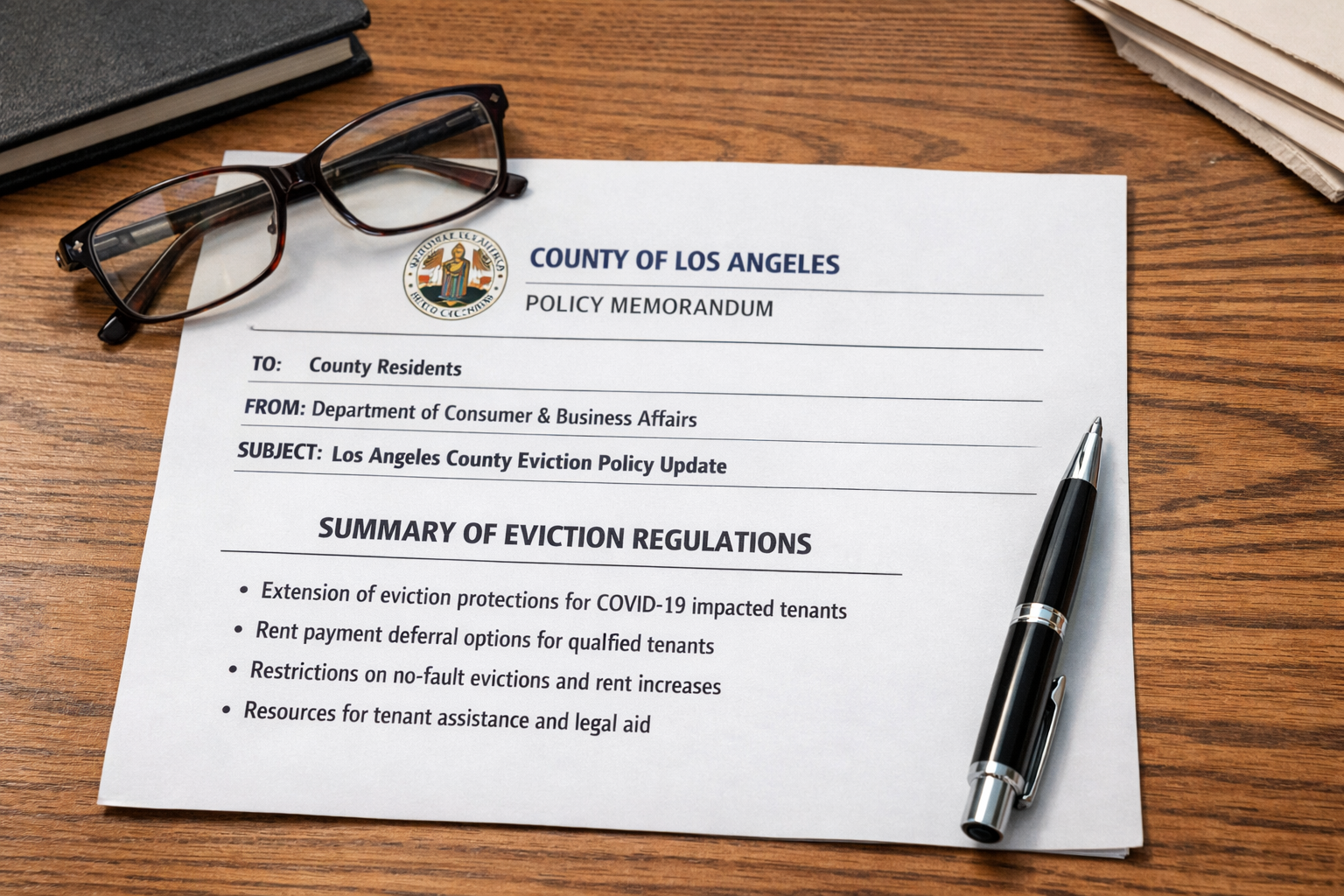
The County’s Rent Stabilization Program page states that, effective April 16, 2026, the FMR threshold for rental units increased to two months. Under that rule, a landlord may terminate a tenancy for nonpayment only if the tenant’s past-due rent exceeds two months of the applicable FMR. The County also explains that HUD sets FMR annually and that the number depends on the unit size. (dcba.lacounty.gov)
This change was approved by the Los Angeles County Board of Supervisors in March 2026. Supervisor Janice Hahn’s office said the ordinance received final approval on March 17, 2026, and would go into effect 30 days later. That lines up with the April 16, 2026 effective date shown by DCBA. (hahn.lacounty.gov)
Where it applies — and where it does not
This is the part many owners can get wrong. The County’s 2026 materials tie this threshold to the County’s rent stabilization and tenant protections framework for unincorporated Los Angeles County. In other words, this is not automatically a countywide rule for every city inside LA County. (dcba.lacounty.gov)
That distinction matters because the City of Los Angeles has its own tenant protections. LAHD states that for covered RSO and JCO units in the City, landlords generally may not evict for nonpayment unless the amount owed is higher than one month of Fair Market Rent. So in 2026, an owner in unincorporated LA County may face a 2-month FMR threshold, while an owner in the City of Los Angeles may still be dealing with a 1-month FMR rule for covered units. (housing2.lacity.org)
What this means in practical terms
For owners, this change does not mean rent is optional. It means the point at which a nonpayment eviction can move forward has shifted upward in the relevant County areas. That can affect cash flow timing, collections strategy, and when legal escalation becomes realistic. (dcba.lacounty.gov)
It also means owners need to stop thinking in shorthand like “one missed month = immediate next step.” In covered unincorporated areas, the key metric is now two months of HUD Fair Market Rent, not simply the tenant’s contract rent. Because FMR varies by bedroom count and is updated annually by HUD, owners need to verify the correct number before acting. (dcba.lacounty.gov)
A simple example
If a unit is in unincorporated LA County and subject to the County rule, the relevant question is not just “How much rent is unpaid?” It is “Does the unpaid amount exceed two months of the applicable FMR for that unit size?” DCBA gives this framework directly, and the threshold is tied to HUD’s annual FMR schedule. (dcba.lacounty.gov)
Pro Tip: Before serving or escalating any nonpayment matter, confirm three things first: the property jurisdiction, whether the unit is covered, and the current HUD FMR for that bedroom count. One wrong assumption can create an expensive process problem. (dcba.lacounty.gov)
What owners should do now
1) Confirm jurisdiction
Start with the basics: is the property in the City of Los Angeles, another incorporated city, or unincorporated Los Angeles County? The rule discussed here is specifically described by the County for unincorporated areas. (dcba.lacounty.gov)
2) Review your rent ledger process
If your team still treats “one month behind” as the default trigger for nonpayment escalation everywhere, your workflow may be outdated. Update internal checklists so staff verify the correct threshold before sending communications or making decisions. (dcba.lacounty.gov)
3) Separate operations from legal advice
Your operations team can organize ledgers, notices, communication logs, and payment history. But when it is time to interpret coverage, threshold application, or next legal steps, that is where counsel should come in. County and city housing rules in LA are now too layered to wing it. (dcba.lacounty.gov)
4) Communicate clearly with owners and investors
If you manage for third-party owners, explain that this is a timing and compliance issue, not a philosophy issue. The right move is to operate with current rules, protect documentation quality, and avoid avoidable missteps. (dcba.lacounty.gov)
Local nuance that matters in Los Angeles
One reason this topic causes confusion is that LA housing rules are fragmented. The County, the City of Los Angeles, and other local jurisdictions may all have different thresholds, notice frameworks, and tenant protections. In 2026, LAHD also highlights other recent City-side changes, including rent increase rules, which shows how quickly the regulatory environment keeps moving. (housing.lacity.gov)
That is why owners should avoid broad statements like “LA changed eviction rules” unless they specify which jurisdiction. In this case, the 2-month threshold is best understood as an unincorporated LA County rule change, not a blanket rule for all of Los Angeles County’s cities. (dcba.lacounty.gov)

Rules changed, and sloppy assumptions can get expensive. If you want a cleaner operating process around rent collection, owner communication, and jurisdiction-specific property management in Los Angeles County, Start a quick consult with JPMC.
Deck / TL;DR
- In unincorporated LA County, the nonpayment eviction threshold increased to two months of Fair Market Rent effective April 16, 2026. (dcba.lacounty.gov)
- This is not the same thing as saying all cities in LA County follow the same rule. (dcba.lacounty.gov)
- The City of Los Angeles still states a one-month FMR threshold for covered RSO/JCO units. (housing2.lacity.org)
- Owners should verify jurisdiction, coverage, and current HUD FMR before escalating nonpayment cases. (dcba.lacounty.gov)
FAQs
Q: Did LA County really pass a 2-month minimum eviction threshold?
A: Yes. DCBA says that effective April 16, 2026, landlords in covered County areas may only terminate for nonpayment if past-due rent exceeds two months of FMR. (dcba.lacounty.gov)
Q: Does this apply everywhere in Los Angeles County?
A: No. The County materials describe this within the framework for unincorporated Los Angeles County. You should not assume it applies automatically in incorporated cities. (dcba.lacounty.gov)
Q: Is the City of Los Angeles using the same threshold?
A: Not based on LAHD’s current pages. LAHD says covered City units generally use a one-month Fair Market Rent threshold for nonpayment evictions. (housing2.lacity.org)
Q: Is this legal advice?
A: No. This article is informational only. Owners should confirm facts with current official sources and speak with qualified counsel for property-specific advice. (dcba.lacounty.gov)
What to do next
- Check whether your property is in unincorporated LA County or a city jurisdiction.
- Update your rent collection and escalation workflow to reflect the 2026 threshold where applicable.
- Review your portfolio with a property manager and attorney before treating old rules like they still apply.
— External Sources —
[1] Los Angeles County DCBA Rent Stabilization Program page. (dcba.lacounty.gov)
[2] Supervisor Janice Hahn press release on final approval, March 17, 2026. (hahn.lacounty.gov)
[3] LAHD Just Cause for Eviction Ordinance page for City of Los Angeles comparison. (housing2.lacity.org)
2 Responses
I Love the Christmas Parade in Montrose! See you there!!!
I was more than happy to seek out this internet-site.I needed to thanks in your time for this wonderful read!! I positively enjoying every little little bit of it and I have you bookmarked to check out new stuff you weblog post.